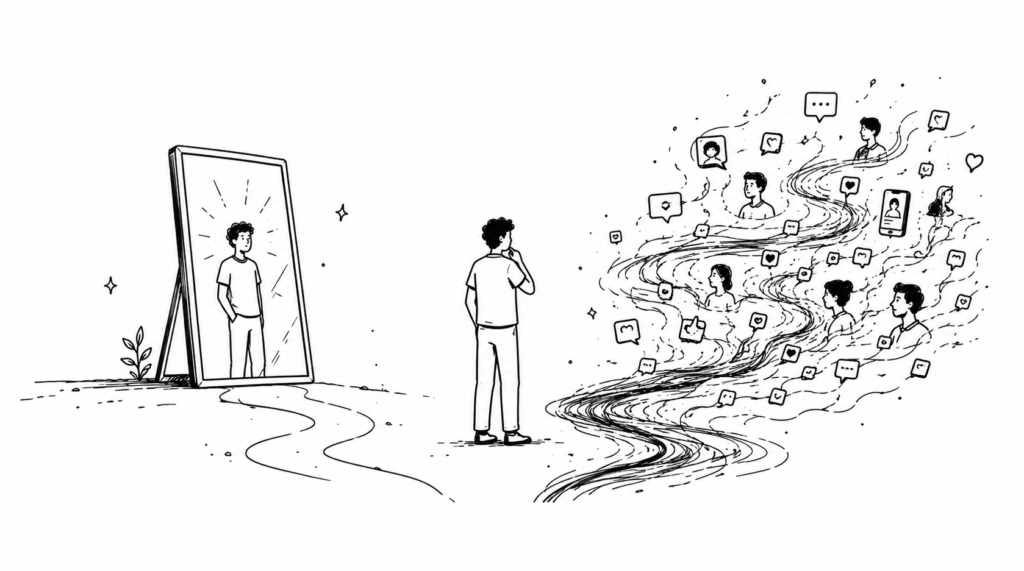
One question that often comes to my mind is whether social media creates opinions or simply exposes opinions that already exist within us.
When I look back at my own life, I realize the answer is not straightforward. Social media has certainly influenced me, but it has also helped me discover parts of myself that I didn’t fully understand before.
Before Social Media: Uncertain but Curious
During my intermediate years, I was skeptical about social media.
I wasn’t sure whether I even wanted an online presence. Looking back, I think a major reason was that I wasn’t completely sure who I was. I had interests and preferences, but I hadn’t yet developed a strong sense of identity.
Academically, I was never considered a bright student. However, sports was a different story.
Around athletes and people interested in sports, I felt confident. I performed better, communicated better, and felt like I belonged. In those environments, I saw a different version of myself—someone capable and respected.
Technology was also unfamiliar to me. While smartphones and the internet were becoming common, I was still learning the basics. Because of that, social media felt like an unknown world that I wasn’t ready to enter.
How the Internet Strengthened My Confidence
Growing up, I was often judged based on marks.
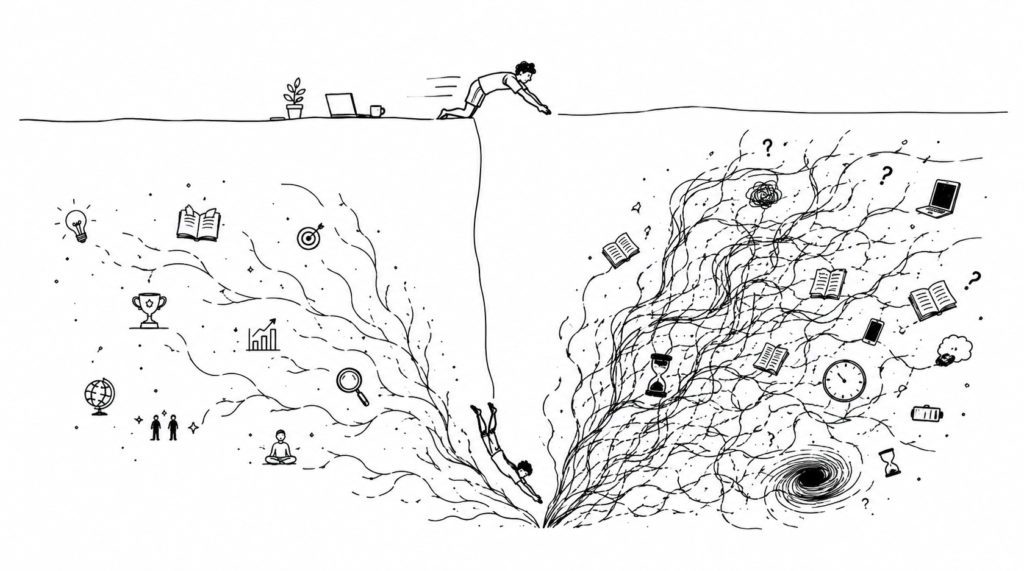
The focus was always on becoming a good student rather than becoming a good learner. Success was measured through grades, not curiosity. Nobody really taught me how to think, solve problems, or understand the world around me.
The internet changed that.
For the first time, I discovered content that made learning exciting.
Shows like Man vs. Wild fascinated me because they showed what humans are capable of when pushed to their limits. Later, YouTube channels like Vsauce opened an entirely different world for me.
Suddenly, I was learning about science, psychology, history, theories, and the hidden mechanisms behind everyday life.
More importantly, these experiences changed the way I saw myself.
I realized that understanding the world was not reserved for genius students. Curiosity mattered more than marks. I began to believe that I could learn, understand, and grow just like anyone else.
That may sound simple, but it was a major shift in my mindset.
The Internet Showed Me Both Sides of Reality
The internet did not only expose me to inspiring ideas.
It also exposed me to the darker side of life.
Over time, I realized that the world is not entirely good or entirely bad. Human beings are capable of kindness, creativity, and progress. At the same time, they are capable of cruelty, manipulation, and destruction.
Social media gave me access to both realities.
While some knowledge expanded my thinking, other content reminded me that life is complicated and often unfair.
Instead of rejecting one side, I learned that understanding both is necessary if we want to see the world honestly.
How My Beliefs About God Changed
If there is one major belief that changed because of the content I consumed, it would be my views on religion and God.
Until intermediate, I rarely questioned these beliefs.
Later, I began asking difficult questions.
Why should I believe in God?
Why is every success credited to God?
What does prayer actually do?
What happens when people visit temples and pray?
These questions were influenced by people whose ideas challenged my existing beliefs.
For a period of time, I identified as an atheist. I questioned almost everything related to religion and spirituality.
However, as I grew older, my perspective evolved again.
I realized that belief is deeply personal. People find meaning, comfort, strength, and hope in different ways. As long as someone is not harming others, they have the right to practice their beliefs.
Today, I may not have all the answers, but I have learned to respect different viewpoints.
Do I Verify Information Before Accepting It?
Honestly, not as much as I should.
If I had to estimate, I probably verify less than 30% of the information I consume.
However, I tend to follow creators and sources that have built credibility over time. I also prefer content that provides facts, numbers, examples, or thoughtful reasoning.
When I share information with others, I usually make an effort to cross-check it first.
My approach is less about verifying every single piece of content and more about consuming information from multiple perspectives. By hearing different viewpoints, I try to identify the core truth rather than blindly accepting one person’s opinion.
Am I Choosing Content, or Is the Algorithm Choosing for Me?
I think the answer is both.
Maybe fifty percent is my choice and fifty percent is the algorithm’s choice.
Recently, I have noticed a large amount of content around gender debates, feminism, men’s rights, and social conflicts. Much of this content is designed to trigger emotional reactions.
The more you engage, the more similar content appears.
At the same time, platforms know a lot about us. They understand our interests, conversations, search history, and engagement patterns.
On Instagram alone, I follow thousands of pages.
Yet despite following so many accounts, I constantly receive content from creators I have never seen before. The platform keeps introducing new content that it believes will capture my attention.
Whether I consciously choose it or not, the algorithm plays a significant role in shaping what I consume every day.
What Beliefs Would Remain If Social Media Disappeared Tomorrow?
If social media disappeared tomorrow, many of my core beliefs would remain unchanged.
I would still believe in sports.
I would still believe in staying active.
I would still believe in spending time outdoors and connecting with nature.
I would still believe that every person deserves respect.
I would still believe that people need close friends and trusted circles where they can express their thoughts freely without fear of judgment.
Most importantly, I would probably spend more time with my own thoughts.
Social media has given me knowledge, entertainment, and opportunities to learn. But it has also taken a significant amount of my attention.
If it disappeared tomorrow, I would likely use that time to work on myself, reflect more deeply, and focus on areas where I need improvement.
My Final Thought
Looking back, I don’t think social media created me.
But I also don’t think it left me unchanged.
It amplified some beliefs, challenged others, and exposed me to perspectives I would never have encountered otherwise.
The biggest lesson it taught me is that learning does not stop after school.
A person does not need perfect grades to understand the world.
Curiosity, openness, and the willingness to question are often more valuable than certainty.
Social media may influence what I see, but the responsibility of deciding what to believe still belongs to me.